Parks and Recreation
Parks and Recreation - step 1 - The Present
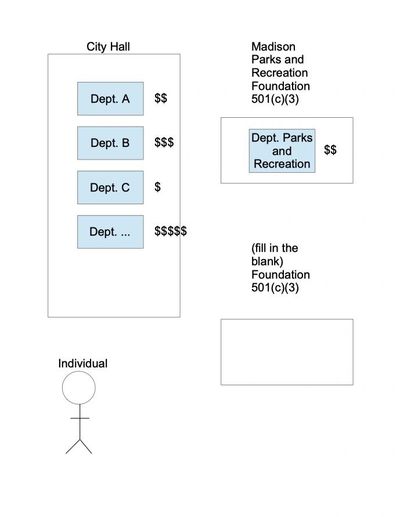
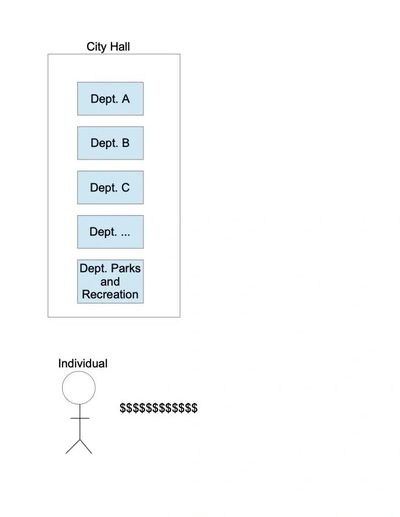
The Parks and Recreation Department is inside City Hall.
There are many departments within City Hall.
The Individual represents you, a taxpayer.
You have money (the number of $'s is not significant).
"The total proposed budget for 2026 is $15.9 million, not including the utilities budget of $9.8 million and $25.7MM with utilities." [page 2]
The spending for Parks and Recreation will be $1,323,361 [page 4].
Therefore the Parks and Recreation Department represents 5.15% of the total budget.
From 1838 to 2025, Madison has had 39 mayors (https://www.madison-in.gov/topic/index.php?topicid=52&structureid=18).
1 served 13 years.
1 served 12 years.
1 served 9 years.
2 served 8 years.
2 served 7 years.
6 served 6 years.
2 served 5 years.
9 served 4 years.
7 served 3 years.
7 served 2 years.
1 served less than 1 year.
The reason this is relevant is that many Parks and Recreation projects take multiple years, and might last longer than one mayor's term of 4 years.
A new mayor might discontinue existing projects.
There is therefore very little continuity and stability.
Parks and Recreation - step 2
City Hall decides how much taxes you will pay.
City Hall coerces you to pay taxes.

Parks and Recreation - step 3
What started out as your money is now "our" "public" money within City Hall.
Parks and Recreation - step 4
City Hall (as part of its budgeting process) decides how much of "our" "public" money will be allocated to each department.
Departments compete for money in a highly political process.
You have no input into this process.
You probably disagree with how much money each department is allocated.
City Hall has no incentive to spend "our" "public" money as wisely or as efficiently as you would spend your own money.
Parks and Recreation - step 5
The Cutting Back City Hall Party will create a new 501(c)(3) non-profit organization called "Madison Parks and Recreation Inc." (MPRI).
Parks and Recreation - step 6
The Cutting Back City Hall Party will migrate the entire Parks and Recreation Department from inside City Hall to inside MPRI.
All of its assets (e.g. real estate, mechanical equipment, staff, funds) will be migrated.
All of its liabilities (e.g. debt) will be migrated.
Parks and Recreation - step 7
Once the Parks and Recreation Department is no longer inside City Hall, there is no need to City Hall to have the $ that was previously allocated to that department.
Parks and Recreation - step 8
City Hall can now return that $ back to you.
Even better than taxing you and returning some $ back to you,
City Hall can simply cut your taxes.
By how much?
By the 5.15% that represents the portion of the total budget that is spent on Parks and Recreations.
Who wouldn't like to cut their taxes by 5.15%?
Parks and Recreation - step 9
Now that your taxes have been cut, what can you do with the $?
Parks and Recreation - step 10
You can choose to donate it to MPRI.
Parks and Recreation - step 11
Inside City Hall, all of the departments have the same amount of $ as they did previously.
Inside MPRI, the Parks and Recreation Department has the same amount of $ as it did previously.
You have the same amount of $ as you did previously.
It may look like nothing has changed, but a lot of changed, all of it in your favor.
Instead of City Hall coercing you to pay for Parks and Recreation, it is now your choice.
Instead of City Hall deciding how much to tax you, it is now your choice how much to donate.
Instead of City Hall having no incentive to spend "our" "public" money wisely and efficiently, MPRI has a strong incentive to spend its donations wisely and efficiently, because if it doesn't, donors will reduce or eliminate their donations.
Instead of competing for funding in a highly political process inside City Hall, MPRI has no internal competition for funding.
Because projects in the Parks and Recreation Department no longer depend on the mayor (see step 1), they have far higher continuity and stability.
Parks and Recreation - step 12
There are several non-profit organizations out there.
They might have money that they would like to donate to the Parks and Recreation Department.
As long as the Parks and Recreation Department is inside City Hall, they might be reluctant to donate to City Hall (who knows what they will do with the money?).
Parks and Recreation - step 13
Other non-profit organizations would not be reluctant to donate to MPRI, as it is outside of City Hall.
Parks and Recreation - step 14
The Parks and Recreation Department now has more money than it ever had.